Drawing maps of places from memory
Draw a place from memory and you learn how little you looked at it. Then walk it again.

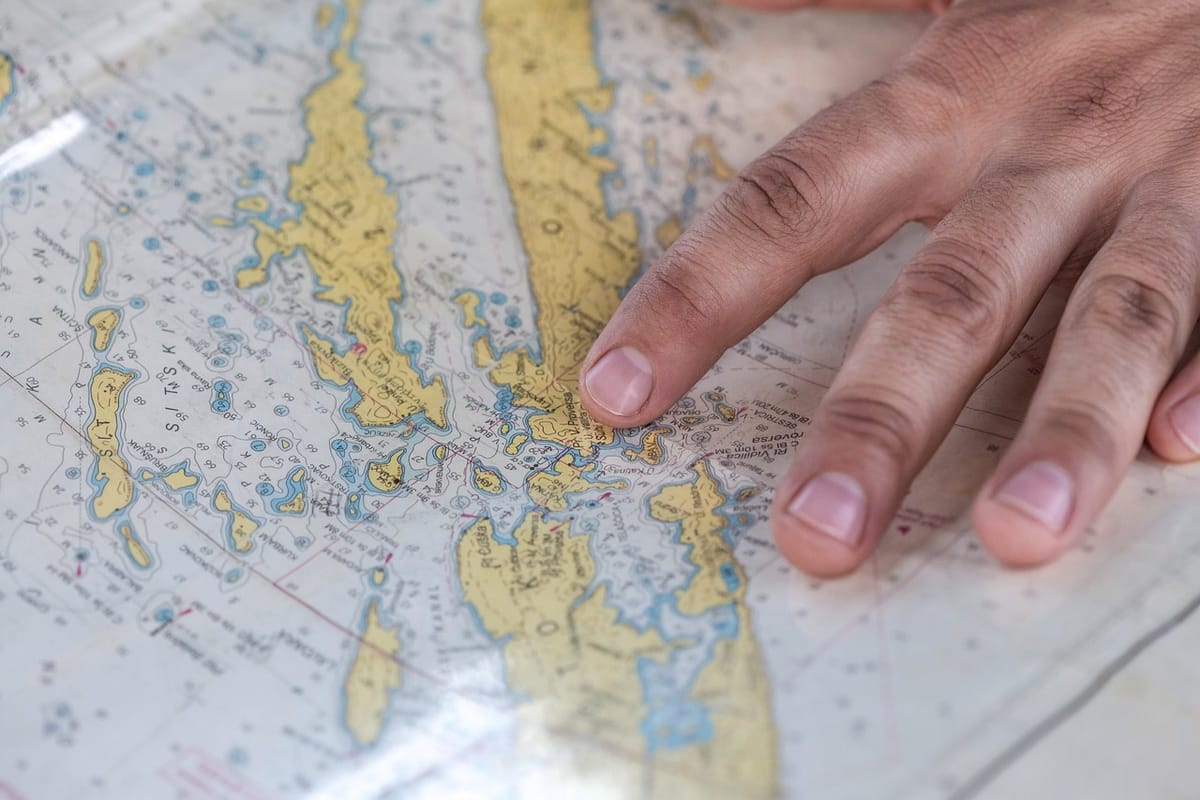
I cannot draw. I want to say that first, because this is a post about drawing maps, and every map in it is wobbly, badly scaled and full of crossings-out. It is also about the best way I know to remember a place: to draw it from memory, get it wrong, and go back to check.
How it started
On a walking holiday in Wales, it rained for four days. I sat in a café with a pencil and tried to draw the valley we had walked the day before: the river, the farm, the bridge, the hill with the mast. I got almost everything wrong. The farm was on the other side of the river. The bridge did not exist. ((There was a ford. I had walked through it. My boots remembered even if I did not.))
The next day we walked the valley again, and I saw it for the first time.
The method
- Walk somewhere.
- The same day, draw it from memory: paths, water, buildings, hills, the things you noticed.
- Mark what you are unsure of with a question mark.
- Walk it again, and correct the map in a different colour.
The corrections are the best part. Every red line is something I looked at and did not see.
What maps remember
A drawn map is not a navigation tool. It is a record of attention: what was big to you, what you missed, what you noticed that no official map would show. On my maps there is a gate that squeaks, a tree where an owl lives, and a bench with a view "better in the evening".
Official maps show the land. Drawn maps show your walk through it.
Draw a place from memory and you will learn exactly how little you looked at it.
Scale, and why it does not matter
My maps are hopeless at scale. The walk to the pub is always too short and the climb up the hill always too long. I have stopped correcting this, because it is true in a different way: that is how far those distances felt.
Still a seedling
This post is marked as a seedling because the idea is still growing. I want to try maps of places I only know from one visit, maps of my street drawn once a year, and a map of my grandmother's kitchen drawn from memory by everyone in my family, to see how many kitchens there really were.
If you try any of these, I would love to see them.
Maps as letters
Last month I drew a map of my morning walk and posted it to a friend in Osaka who has never been here. She drew her walk to work and posted it back. Hers had a vending machine, a shrine, a cat that sits on the same wall every morning, and a bakery marked "best at 7:40". I have never been to her street, and now I feel I could walk it.
I think this might be the best use of a bad map: not to find your way, but to share how a place feels to the person who knows it. We are going to swap one map every season.
Drawing with children
My niece, who is seven, draws better maps than I do. She draws what matters: the swing, the dog that barks, the house with the red door where her friend lives. Scale does not interest her at all. Her map of the park is mostly the ice-cream van. ((It is, to be fair, the most important thing in the park.))
A map exercise for this week
Choose a place you visit often but have never really looked at: a supermarket, a park, the street outside your office. Draw it from memory, in five minutes, with a pencil. Mark everything you are unsure of with a question mark. The next time you are there, look for the question marks. Correct the map in a different colour when you get home. Keep both versions. You will be surprised by what you remembered, and by what you walked past a hundred times.